
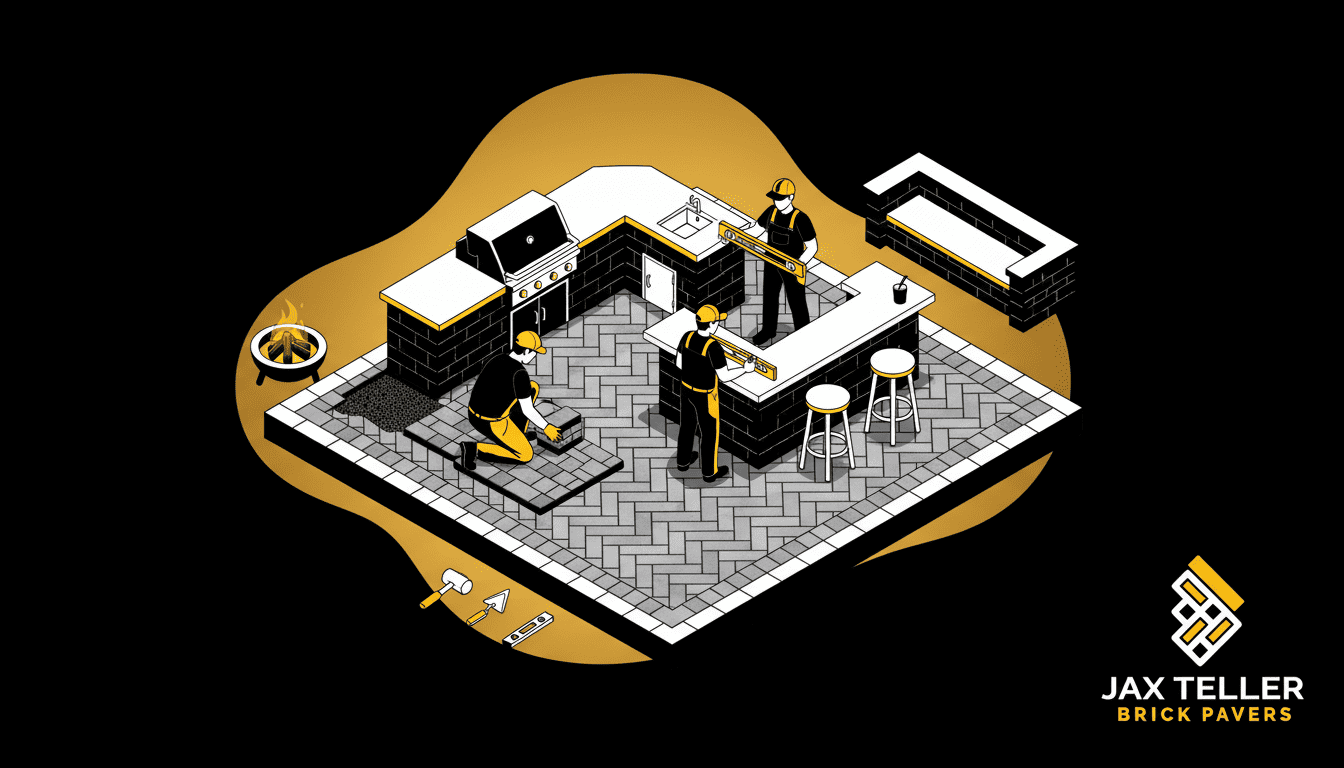
Learning how to design an outdoor kitchen with pavers in Largo, FL is the starting point for any homeowner who wants to transform their backyard into a fully functional, year-round entertaining space. Florida’s climate makes outdoor living not just possible but genuinely preferable — and a well-designed paver-based outdoor kitchen is one of the highest-value upgrades you can make to any residential property in Pinellas County.
However, an outdoor kitchen is far more complex than a standard patio installation. The surface must support concentrated structural loads from grills, countertops, refrigeration units, and masonry structures. In addition, it must manage grease, moisture, heat, and heavy foot traffic simultaneously — all while holding up against Florida’s intense sun and seasonal storms. For this reason, the materials you choose and how they are installed matter enormously.
This guide walks through every critical element of outdoor kitchen design with pavers in Largo — from surface material selection and layout planning to drainage, base preparation, and the design features that separate a functional cooking station from a truly spectacular outdoor living space.
Why Pavers Are the Best Surface for Outdoor Kitchens in Florida
Designing an outdoor kitchen with pavers in Largo, FL starts with understanding why pavers consistently outperform every alternative surface in Florida’s demanding environment. Poured concrete — the most common alternative — is rigid and prone to cracking under soil movement, thermal expansion, and the concentrated point loads created by heavy kitchen structures. Once concrete cracks beneath an outdoor kitchen, repair becomes complex and expensive.
Pavers, in contrast, flex slightly with ground movement. This flexibility prevents the fracture lines that develop in solid slabs over time. Furthermore, the joint system between individual paver units allows water to drain through or around the surface rather than pooling beneath it — a critical advantage in Largo, where summer storms can saturate the ground rapidly.
Additionally, if a paver unit is damaged by a dropped grill grate, grease stain, or thermal stress near a fire feature, that individual unit can be lifted and replaced without disturbing the surrounding surface. This repairability makes pavers a far more cost-effective long-term solution than any monolithic slab. Most importantly, pavers offer a design flexibility that concrete simply cannot match — allowing you to create a kitchen surface that is as visually refined as it is structurally sound.
Choosing the Right Paver Material for Your Outdoor Kitchen
Material selection is one of the most consequential decisions in outdoor kitchen design. Each option brings a different balance of performance, aesthetics, and maintenance requirements — and the right choice depends on your kitchen’s proximity to the grill, pool, or other heat and moisture sources.
Concrete Pavers — Durable, Versatile, and Budget-Friendly
Concrete pavers are the most popular choice for outdoor kitchen surfaces in Largo. They are widely available, come in a broad range of shapes, colors, and textures, and handle heat, moisture, and heavy loads reliably when properly sealed. For most residential outdoor kitchen projects, concrete pavers in a tumbled or textured finish deliver an excellent balance of performance and visual appeal at a competitive price point.
However, concrete pavers are susceptible to UV fading over time without periodic resealing. Therefore, scheduling professional pressure washing and sealing every two to three years is essential to maintain both appearance and surface integrity in Florida’s intense sun.
Travertine Pavers — Premium Performance Around Heat and Moisture
Travertine is the premium choice for outdoor kitchens in Largo — particularly for spaces that integrate with a pool deck or spa area. Its natural composition keeps the surface significantly cooler underfoot than concrete or brick, which matters enormously in a zone where people stand barefoot while cooking or entertaining. Additionally, travertine’s natural texture provides excellent slip resistance even when wet.
Furthermore, travertine’s neutral, timeless tones pair seamlessly with both modern stainless-steel kitchen structures and traditional stone masonry facades. It does, however, require sealing to prevent staining from grease and food spills — a straightforward maintenance step that protects the surface for years. For homeowners who want a truly resort-quality outdoor kitchen, travertine is the clear top-tier choice in the Largo market.
Brick Pavers — Classic Warmth and Proven Longevity
Brick pavers bring a warmth and character to outdoor kitchens that manufactured concrete products struggle to replicate. Their rich, earthy tones complement natural wood cabinetry, stone countertops, and lush Florida landscaping beautifully. In addition, brick pavers are extremely durable under heavy use — historically proven in commercial and industrial applications that exceed the demands of any residential kitchen.
On the other hand, brick pavers can absorb grease more readily than sealed concrete or travertine if left unsealed. Consequently, sealing is strongly recommended for the cooking zone immediately surrounding the grill station. Beyond that zone, unsealed brick can work well for dining and lounge areas where spill risk is lower and a more natural, aged aesthetic is desired.
Outdoor Kitchen Layout Planning with Pavers
Layout planning is where design ambition meets practical engineering. In Largo, the best outdoor kitchen layouts are those that optimize traffic flow, separate cooking zones from dining and lounge areas, and account for prevailing wind direction — ensuring smoke moves away from seating areas rather than toward them.
The Linear Layout — Efficient and Space-Smart
The linear layout positions all kitchen elements — grill station, prep surface, sink, and storage — along a single wall or edge of the patio. This is the most space-efficient configuration and works well for mid-size backyards in Largo where the outdoor kitchen shares patio space with a dining table and lounge seating.
In a linear layout, the paver surface typically extends 4 to 6 feet outward from the kitchen structure — providing ample workspace and foot traffic clearance without consuming the entire patio footprint. Additionally, a contrasting paver border around the kitchen structure itself helps define the cooking zone visually and separates it cleanly from the surrounding entertainment area.
The L-Shaped Layout — More Counter Space, Better Flow
The L-shaped layout wraps the kitchen around two adjacent walls or angles, creating significantly more counter space and the opportunity to define a natural bar-seating zone along one arm of the L. This configuration is ideal for homeowners in Largo who entertain frequently and want guests to interact with the cook without crowding the working kitchen space.
From a paver design perspective, the L-shaped layout creates an interesting opportunity to use pattern zoning — for example, a herringbone field within the cooking zone and a running bond pattern in the adjacent dining area — to define spaces visually without using any physical barrier. This approach adds design sophistication while maintaining an open, flowing layout.
The U-Shaped Layout — The Full Entertainer’s Kitchen
The U-shaped outdoor kitchen wraps around three sides of a defined patio zone, creating a fully enclosed cooking environment with abundant counter space, dedicated zones for grilling, prep, bar service, and refrigeration, and a natural enclosure for guests to gather around. This is the most expansive layout option and suits larger Largo backyards where outdoor living is a primary design priority.
However, U-shaped layouts require careful paver base engineering because the kitchen structure creates point loads at multiple corners and along all three walls simultaneously. Therefore, the compacted base beneath a U-shaped outdoor kitchen must be engineered to distribute those loads evenly — typically requiring a deeper gravel base and, in some cases, a reinforced concrete footing beneath the kitchen structure itself. Our team at JaxTeller Brick Pavers routinely handles this level of base engineering for complex outdoor kitchen projects across Largo.